
Towards a Perfect Nanomaterial / Photoluminescence signals in a scattering-type scanning near-field optical microscope
CIC nanoGUNE Seminars
- Speaker
-
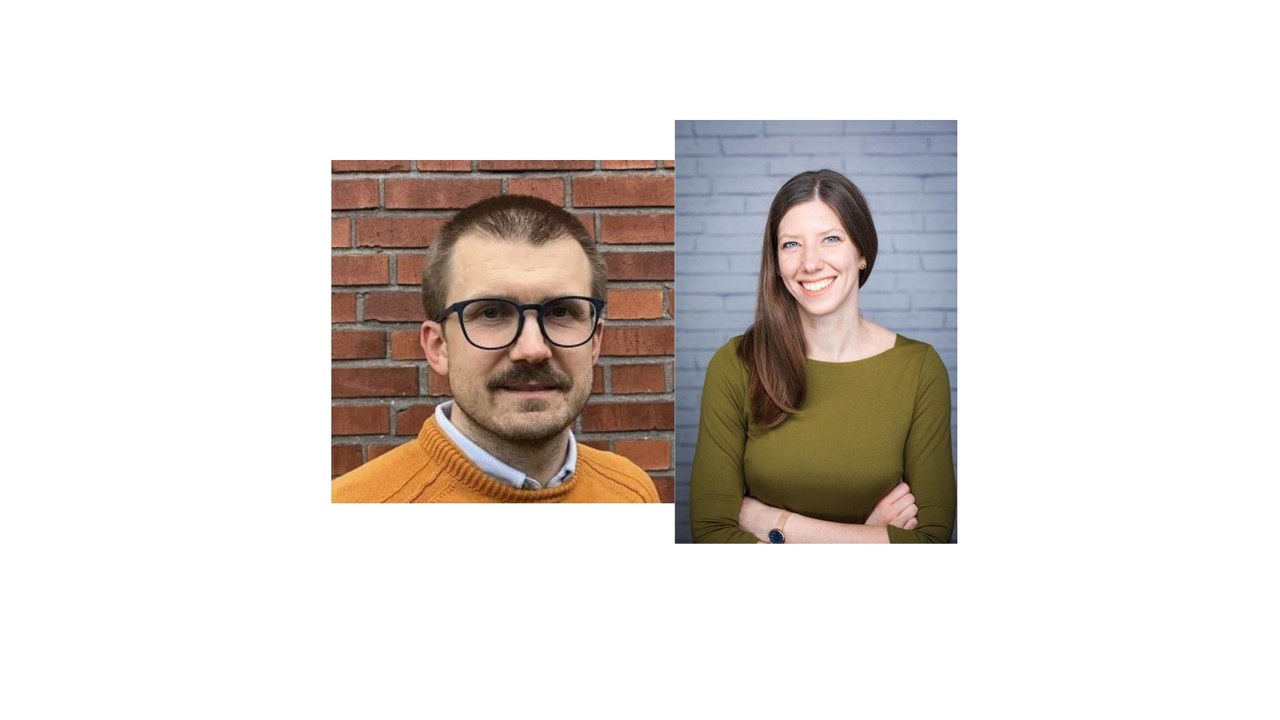
Ass. Prof. Dmitry Baranov & Jun. Prof. Iris Niehues
Lund University / Universität Münster - When
-
2026/02/12
10:30 - Place
- CIC nanoGUNE Seminar room, Tolosa Hiribidea 76, Donostia-San Sebastian
- Host
- Beatriz Martin-García
- Add to calendar
-
 iCal
iCal
Talk 1 - Disorder is an intrinsic feature of all solids, from crystals of atoms to superlattices of colloidal nanoparticles. In nanocrystal superlattices, misplaced particles can displace their neighbors over long distances, leading to cumulative disorder. This collective displacement leaves clear signatures in diffraction and presents a potential obstacle for utilizing superlattices in quantum technologies, where it may cause energetic disorder and limit coherence and collective states.
In this talk, I will discuss our efforts to rationalize the propagation and accumulation of disorder in superlattices made of colloidal CsPbBr3 nanocubes. By tuning nanocrystal softness through size and surface chemistry, we observe progressive ordering of superlattices through combination of synchrotron X-ray scattering experiments and multilayer diffraction analysis. A sinusoidal displacement model is proposed to rationalize experimental observations and explain how softness governs structural order. These findings suggest that the path to the “perfect” nanocrystal superlattice lies in tuning the softness, opening the door to engineering nanocrystal solids with minimal disorder for the exploration of collective phenomena, perhaps in the quantum domain.
Relevant publications:
1. Filippi et al., ACS Nano 2026, ASAP, https://doi.org/10.1021/acsnano.5c20745
2. Filippi et al., Adv. Mater. 2025, 27, e2410949, https://doi.org/10.1002/adma.202410949
Talk -2- Color centers in hexagonal boron nitride (hBN) have emerged as interesting quantum light sources due to their stable and bright single-photon emission at room temperature. In this talk I will follow up on my results on the observation of these emitters in hBN measured in a near-field microscope. I will give an answer to the open question of my last nanoGUNE seminar “What causes the banana?”
We employ the near-field optical microscope in tapping mode, to detect PL signals from the color centers influenced by the presence of the metallic tip [1]. On the one hand, we demonstrate direct near-field optical excitation and emission through interaction with the nanofocus of the tip resulting in a sub-diffraction limited tip-enhanced PL hotspot. On the other hand, we observe a more pronounced ‘arc’ (banana) around the color center. We explain this feature by constructive interference between direct beams to/from the color center and those scattered from the AFM tip (indirect beam) leading to a significant increase of the recorded PL intensity. We employ this signal to map the in-plane dipole orientations of the hBN color centers on the nanoscale. This work promotes the widely available s-SNOM approach to applications in the quantum domain including characterization and optical control of nanoscopic objects, paving the way to multi-frequency and multi-messenger operation.
Relevant publications:
1. Niehues et al., Nanophotonics 14, 335-342 (2025)
About the speaker
Dmitry Baranov is an Assistant Professor at Lund University, Sweden. He received his Ph.D. in Chemistry from the University of Colorado Boulder and worked as a postdoctoral researcher at the Italian Institute of Technology in Genova, Italy. In Lund, Dmitry leads a Nanochemistry and Spectroscopy research group in Lund, focusing on the self-assembly of colloidal nanocrystals and collective phenomena.
Iris Niehues is a Junior-Professor at the University of Münster, Germany. She received her PhD in Physics from the University of Münster and worked as a postdoctoral researcher at the nanoGUNE institute in San Sebastián, Spain. In Münster Iris leads the Quantum Nanophotonics group. Her research focusses on the fundamental optical properties on the nanoscale of 2D materials and single-photon emitters to develop novel functionalities for quantum technology applications. Her group is funded by the NRW return program on quantum technology.