PhD Thesis Defense | Ivan Žugec
CFM Seminars
- Speaker
-
Ivan Žugec
CFM - When
-
2026/03/06
10:00 - Place
- CFM Auditorium
- Host
- Supervisors: Maite Alducin and J.Iñaki Juaristi
- Add to calendar
-
 iCal
iCal
Alleviating the computational burden of ab initio methods with deep learning: from photoinduced surface reactions to long-lasting molecular dynamics
SUMMARY
In this thesis, machine learning potentials are developed and applied to gas-surface systems with the aim of circumventing the computational limits imposed by the complexity of ab initio methods. The work focuses on two main topics. The first concerns photoinduced desorption and oxidation of CO on the Ru(0001) surface.
Neural network potential energy surfaces based on the EANN and REANN frameworks are constructed and trained on data from ab initio molecular dynamics with electronic friction. These potentials enable large-scale simulations that reproduce experimental CO and CO2 desorption yields, reveal a dynamic trapping mechanism, and allow simulations of two-pulse correlation experiments. The second
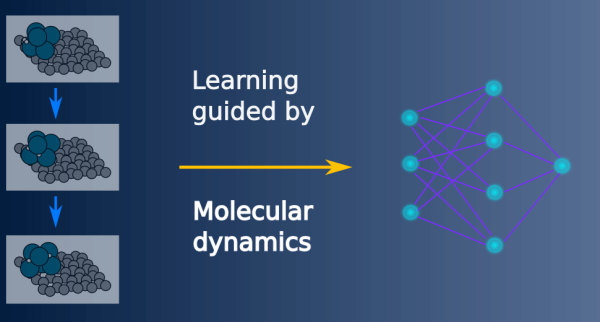
topic introduces dynamic training, a novel methodology that incorporates molecular dynamics directly into the training of neural network potentials. Applied to an equivariant graph neural network, dynamic training improves force accuracy, generalization, and long-time stability. These benefits come at the cost of increased training time but, crucially, do not increase inference time.
Neural network potential energy surfaces based on the EANN and REANN frameworks are constructed and trained on data from ab initio molecular dynamics with electronic friction. These potentials enable large-scale simulations that reproduce experimental CO and CO2 desorption yields, reveal a dynamic trapping mechanism, and allow simulations of two-pulse correlation experiments. The second
topic introduces dynamic training, a novel methodology that incorporates molecular dynamics directly into the training of neural network potentials. Applied to an equivariant graph neural network, dynamic training improves force accuracy, generalization, and long-time stability. These benefits come at the cost of increased training time but, crucially, do not increase inference time.