
First 2D discrete time crystal in a quantum computer
2026
Jan
30
The research published in Nature Communications, involving scientists from Basque Quantum (BasQ), NIST, and IBM, demonstrates how it is possible to create two-dimensional time crystals using state-of-the-art quantum computing infrastructure and techniques. The study was conducted using an IBM Quantum Heron processor, one of the most advanced architectures developed by IBM.
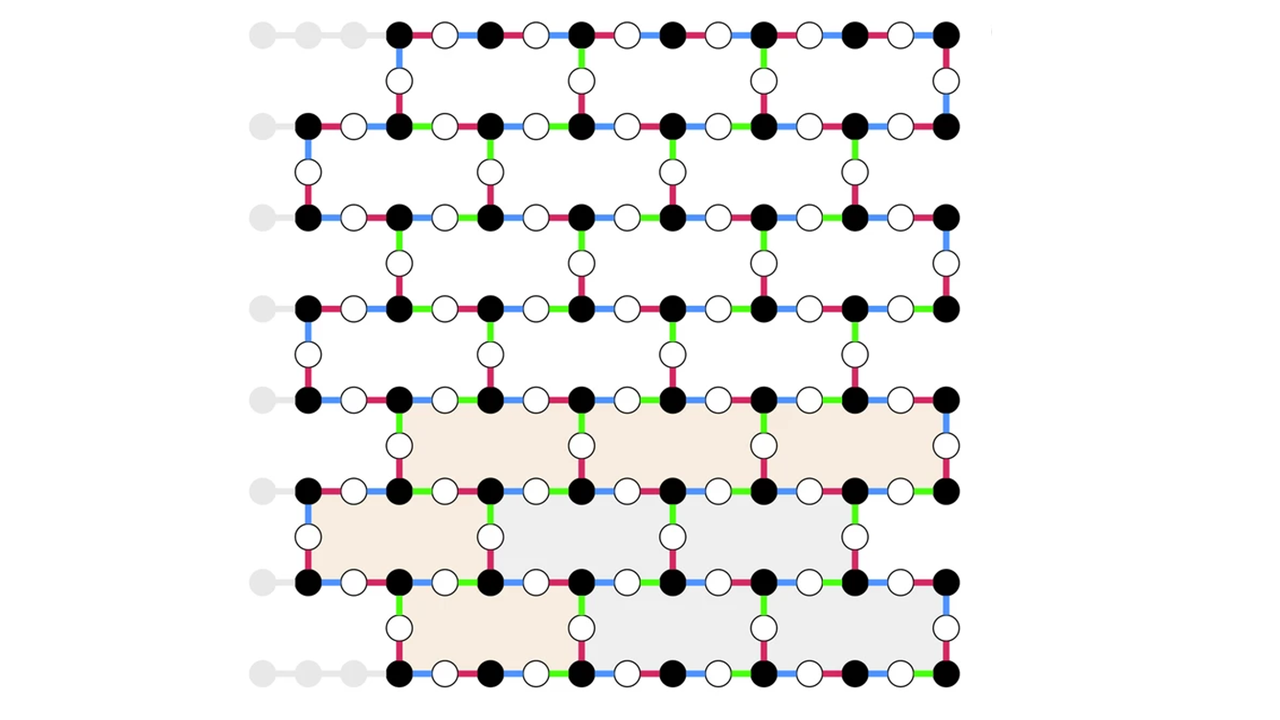
The research published in Nature Communications, involving scientists from Basque Quantum (BasQ), NIST, and IBM, demonstrates how it is possible to create two-dimensional time crystals using state-of-the-art quantum computing infrastructure and techniques.
The study was conducted using an IBM Quantum Heron processor, one of the most advanced architectures developed by IBM. This type of processor powers the new generation of IBM Quantum System Two systems, including the first of its kind deployed in Europe at the IBM–Euskadi Quantum Computational Center in Donostia/San Sebastián.
According to Javier Aizpurua, scientific director of BasQ and researcher at DIPC, "this publication represents a very important step on the path we have been following since the inception of Basque Quantum. It is the result of joint work by research teams from CFM-MPC and DIPC, in close collaboration with IBM, and demonstrates how this cooperation allows us to open up new lines of research and advance our understanding of complex quantum phenomena."
Time crystals are rare physical systems capable of exhibiting stable, repetitive oscillations—or “ticks”—over time, rather than evolving toward a state of equilibrium, as is the case with most known materials. Their internal motion remains synchronized and persistent, making them a subject of great interest for research in fundamental physics. Time crystals are extremely sensitive and complex systems to configure, and so far they have only been produced on a few occasions in laboratories. Their creation requires very precise configurations of particles in highly coherent quantum systems, carefully isolated from heat and noise.
Traditionally, these systems have been investigated in a single dimension, such as in linear chains of atoms where each particle interacts only with its nearest neighbors. Although the existence of time crystals in higher dimensions has been proposed theoretically, their study is particularly complex from a computational point of view. As the number of dimensions increases, interactions multiply and become exponentially entangled, exceeding the ability of classical methods to predict their behavior. This new research by BasQ and IBM overcomes these limitations by demonstrating some of the largest and most complex two-dimensional time crystals to date, in which interactions extend across a grid-like surface structure rather than a chain or line.
The authors of the research managed to develop a two-dimensional time crystal composed of 144 qubits on IBM's Heron quantum computer chip, carefully isolated from heat and external interference. As quantum entities, they do not merely simulate the behavior of a time crystal, but allow it to be directly materialized, using them as its fundamental building blocks. As with any significant discovery in the quantum field, verification of the results is a crucial step. To do this, the team used an advanced technique that involves simulating the quantum state using tensor networks and belief propagation, and then comparing these simulations with the data obtained directly from the quantum computer. In this work, researchers begin to analyze how classical techniques can be used to optimize the execution of quantum processes. To do this, they developed and incorporated new error mitigation methods that improve accuracy and significantly reduce uncertainties in the results obtained.
This advance represents an important step in the exploration of non-equilibrium phases of matter, a key area for understanding advanced quantum phenomena. The ability of quantum computers to simulate these types of systems positions these technologies as fundamental tools for next-generation scientific research.
More information at www.basquequantum.eus.
Publication reference
Eric D. Switzer, Niall F. Robertson, Nathan Keenan, Ángel Rodríguez-Alcaraz, Andrea D’Urbano, Bibek Pokharel, Talat S. Rahman, Oles Shtanko, Sergiy Zhuk, and Nicolás Lorente
Realization of two-dimensional discrete time crystals with anisotropic Heisenberg coupling
Nature Communications 17, 605 (2026).