
Francesca Ferlaino, the scientist behind the new DIPC’s quantum lab, was named ‘Scientist of the Year 2025’ in Austria
2026
Jan
12
Ferlaino was recognized by the Austrian Association of Science and Education Journalists for her outstanding research and her passion in communicating to a broader audience her work on quantum sciences. The Italian physicist, who has conducted front line research in Austria for the past 20 years, joined DIPC to develop the new Ultra Cold Atom Quantum Technologies Lab that will be located at DIPC’s new building
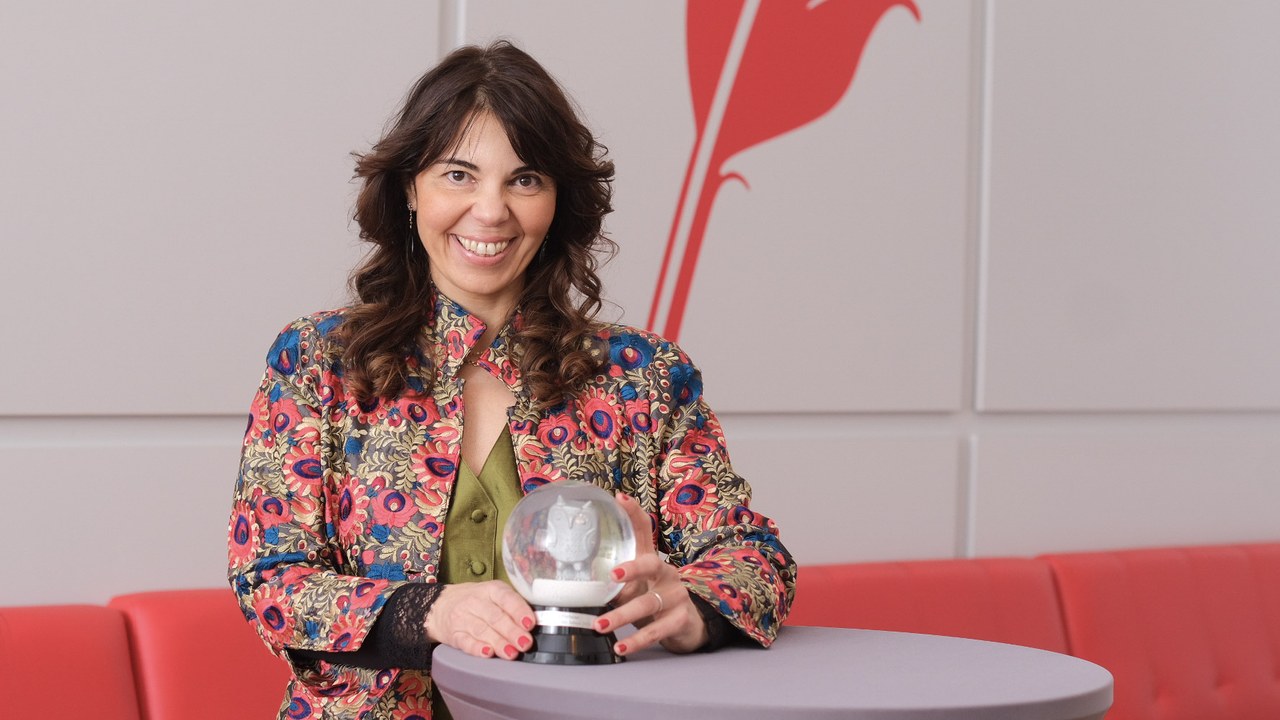
Francesca Ferlaino seems to have been born for physics. In 2012 she achieved the world's first Bose-Einstein condensation of Erbium, a rather unexplored atomic species with extraordinary magnetic properties. In 2018 she obtained the first dipolar quantum merging of Erbium and Dysprosium. In 2019 she was able to create a new state of matter, called supersolid, an elusive, paradoxical state in which superfluid flow and crystalline rigidity coexist. In 2021 she created supersolid states along two dimensions.
For the past 20 years, she has been conducting her research at the Department of Experimental Physics of the University of Innsbruck and has been the Scientific Director of the Institute for Quantum Optics and Quantum Information (IQOQI) of the Austrian Academy of Science in Innsbruck since 2014. More recently, Ferlaino joined DIPC to design and lead the future Ultra Cold Atom Quantum Technologies Lab that will be placed in the new DIPC’s Building, funded by the Department of Science, Universities and Innovation of the Basque Government.
Ferlanio’s enthusiasm for her field has transcended the laboratory and has pushed her to take an active role in the transmission of scientific knowledge to society. Over the years, she has inspired thousands in numerous public events, including the DIPC’s festival Passion for Knowledge 2023, in which she participated as a plenary lecturer alongside with Nobel Laureates and prestigious scientific figures.
She is also strongly committed with the participation of women and gender minorities in quantum sciences. She created the interactive website atom*innen that aims to provide a central and international platform to address gender issues in physics and create a dynamic space for women and gender minorities to share their experiences, seek advice, and collaborate.
In recognition for her outstanding contribution inside and outside the lab, the Austrian Association of Science and Education Journalists has named Francesca Ferlaino ‘Scientist of the Year 2025’. “I am deeply honored by this prestigious recognition. I have always been convinced that science is not a solitary effort, but a shared good whose value grows when knowledge is exchanged and communicated. This award gives special recognition to the importance of science communication and to the role it plays in making research meaningful for society. I am particularly proud if, through my work, I have been able to contribute to a broader understanding of the importance of fundamental science,” says Francesca Ferlaino.
The director of DIPC, Ricardo Díez Muiño, emphazaises the importance of this award: “At DIPC we are extremely pleased by this recognition, which confirms Francesca Ferlaino as one of the leading scientists in quantum physics in Europe. We are especially proud that she has chosen to develop a new quantum technologies laboratory at DIPC. Her arrival represents a remarkable addition to a research activity that is currently experiencing an extraordinary expansion at the center.”
Ultra Cold Atom Quantum Technologies Lab at DIPC
Ferlaino's research focuses on quantum phenomena in atomic gases at ultra-low temperatures. In recent years, she has focused on the strongly magnetic and rather unexplored atoms Erbium and Dysprosium.
At DIPC, Ferlaino will create the Ultra Cold Atom Quantum Technologies Lab, a facility that will push the frontiers of quantum sciences by exploring ultra-cold Dysprosium, and other novel atomic species, using the ultra-high vacuum (UHV) apparatus. This lab is expected to provide a boost in the field of quantum processors based on neutral atoms, a promising pathway for quantum computing hardware for its potential scalability and longer coherence times.
Ferlaino’s lab at DIPC will be part of the Quantum Mile in Ibaeta, an ecosystem of seven research centers supported by the Department of Science, Universities and Innovation of the Basque Government, all of them dedicated to expand the knowledge in quantum sciences and technologies, from the fundamental study of atoms and molecules to the development of applied solutions for quantum computing.
Ferlaino will combine her role as leader of DIPC’s Lab with her current responsibilities at the Institute for Experimental Physics of the University of Innsbruck and the IQOQI of the Austrian Academy of Sciences, expanding and consolidating the collaboration and active exchange between DIPC and Innsbruck in Austria.
Francesca Ferlaino
Ferlaino studied physics at Federico II University in Naples and received her doctorate in 2004 from the University of Florence and the European Laboratory for Non-linear Spectroscopy (LENS). In 2006, she came to Innsbruck as a postdoctoral researcher to work in the research group of Rudolf Grimm, Austria's Scientist of the Year in 2009. A START Prize and an ERC Starting Grant enabled her to establish her own research group in 2009. In 2014, Francesca Ferlaino became a professor of experimental physics at the University of Innsbruck. Since then, she has also been scientific director at the Austrian Academy of Sciences (ÖAW) Institute for Quantum Optics and Quantum Information (IQOQI) in Innsbruck. In 2021, she was elected a member of the Austrian Academy of Sciences (ÖAW) and in 2024 joined DIPC with the goal to create a quantum technologies lab of ultra-cold atoms in Donostia/San Sebastián.
In recent years, she has been awarded two further ERC grants and numerous prestigious prizes and distinctions, including the Erwin Schrödinger Prize, the Feltrinelli Prize, the Alexander-von-Humboldt Chair, the Science Prize of the City of Innsbruck, the Ignaz L. Lieben Prize and the Fritz-Kohlrausch Prize for Experimental Physics. She was also named in the QUANTUM 100 by the UNESCO Board of the International Year of Quantum 2025.