
New simulations suggest clues to the nature of dark matter
2025
Dec
9
Research led by Donostia International Physics Center (DIPC) compares cold, warm, and wave dark matter models to explain surprising galactic shapes seen by the James Webb Space Telescope. The work published in Nature Astronomy opens a new window into the mysterious nature of dark matter
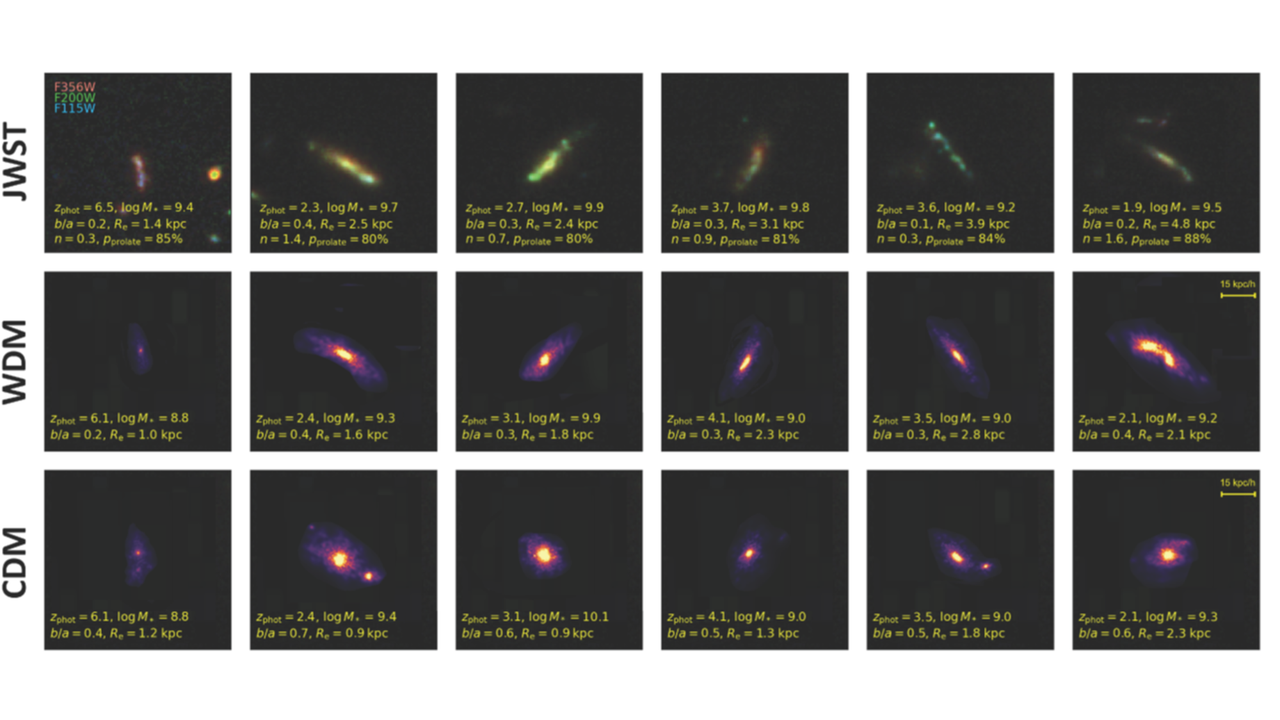
The James Webb Space Telescope (JWST) is revealing the early Universe in unprecedented detail, uncovering young galaxies whose surprisingly elongated shapes challenge existing cosmological models. Now, new research led by Donostia International Physics Center (DIPC), with the participation of researchers from MIT, Harvard University and Taipei , published in Nature Astronomy, suggests that these peculiar forms may hold vital clues to the true nature of dark matter—the invisible substance that makes up most of the Universe’s mass. By comparing cold, warm, and wave dark matter models through state-of-the-art simulations, the team has opened a new window into how the first galaxies formed and evolved.
The unparalleled infrared vision of NASA’s James Webb Space Telescope (JWST) is transforming our understanding of the early Universe. Recent observations have revealed that many young galaxies, formed less than a billion years after the Big Bang, appear strikingly elongated—quite unlike the familiar disk and spheroidal galaxies seen nearby today.
Understanding the origin of these unexpected shapes requires simulating how matter first assembled in the early cosmos. It is generally accepted that pristine gas cooled and condensed within a web of dark matter filaments, igniting the first stars and galaxies. However, state-of-the-art simulations based on the standard Cold Dark Matter (CDM) framework have struggled to reproduce the remarkable degree of elongation observed by JWST.
A new study led by Álvaro Pozo of Donostia International Physics Center (DIPC), published in Nature Astronomy, broadens this comparison by including simulations based on both Warm and Wave Dark Matter models, motivated respectively by sterile neutrinos and by the light axions predicted in String Theory. Wave Dark Matter (WDM) simulations are particularly challenging, requiring a finely resolved grid to follow the de Broglie-scale wave interference together with gas hydrodynamics — a domain in which the team, including simulation experts from MIT, Harvard, and Taipei, has pioneering expertise.
The authors conclude that elongated young galaxies are abundantly produced in both the Warm and Wave DM scenarios, essentially due to the smoother structure of the cosmic filaments in these cases. Gas and stars flow steadily along such filaments, giving rise to prolate, elongated galactic shapes. This comparison can be further tested with upcoming JWST observations — including spectroscopy — and with larger simulation volumes, potentially leading soon to decisive new insights into the still unknown nature of the Dark Matter that dominates our Universe.
In memory of George F. Smoot
We would like to dedicate this work to our friend and mentor, George Smoot, whose wisdom contributed to this joint paper and will have a lasting impact. He passed away shortly after this paper was accepted. In relation to our new paper, we would like to emphasise that George was one of the first to take the light axion interpretation seriously. More broadly, he has inspired all his colleagues with the breadth and depth of his understanding, and with his undiminished pursuit of fundamental questions spanning the entire field. This is evident in his ongoing laboratory development of quantum detectors for astronomy, as well as his theoretical applications of general relativity to interpret gravitational wave events and the nature of dark matter.
Publication reference
Alvaro Pozo, Tom Broadhurst, Razieh Emami, Philip Mocz, Mark Vogelsberger, Lars Hernquist, Christopher J. Conselice, Hoang Nhan Luu, George F. Smoot and Rogier Windhorst
A smooth filament origin for distant prolate galaxies seen by JWST and HST
Nature Astronomy (2025)
DOI: 10.1038/s41550-025-02721-5