
The ninth edition of ‘Cinema and Science’ invites reflection on humanity, nature, and the future
2026
Jan
7
The cycle will kick off today with a screening of Planet of the Apes, a subversive science fiction classic that invites reflection on humanity's progress and setbacks, as well as authoritarian tendencies. This year there will once again be parallel activities, such as a talk by Ginés Morata, biologist and winner of the Princess of Asturias Award for Scientific and Technical Research, and a round table discussion with filmmaker Pilar Palomero and oncologist Ander Urrutikoetxea. Around twenty scientists will engage in discussions with the public at events taking place between January and March in Vitoria, San Sebastián, Bilbao, Pamplona, and Saint-Jean-de-Luz.
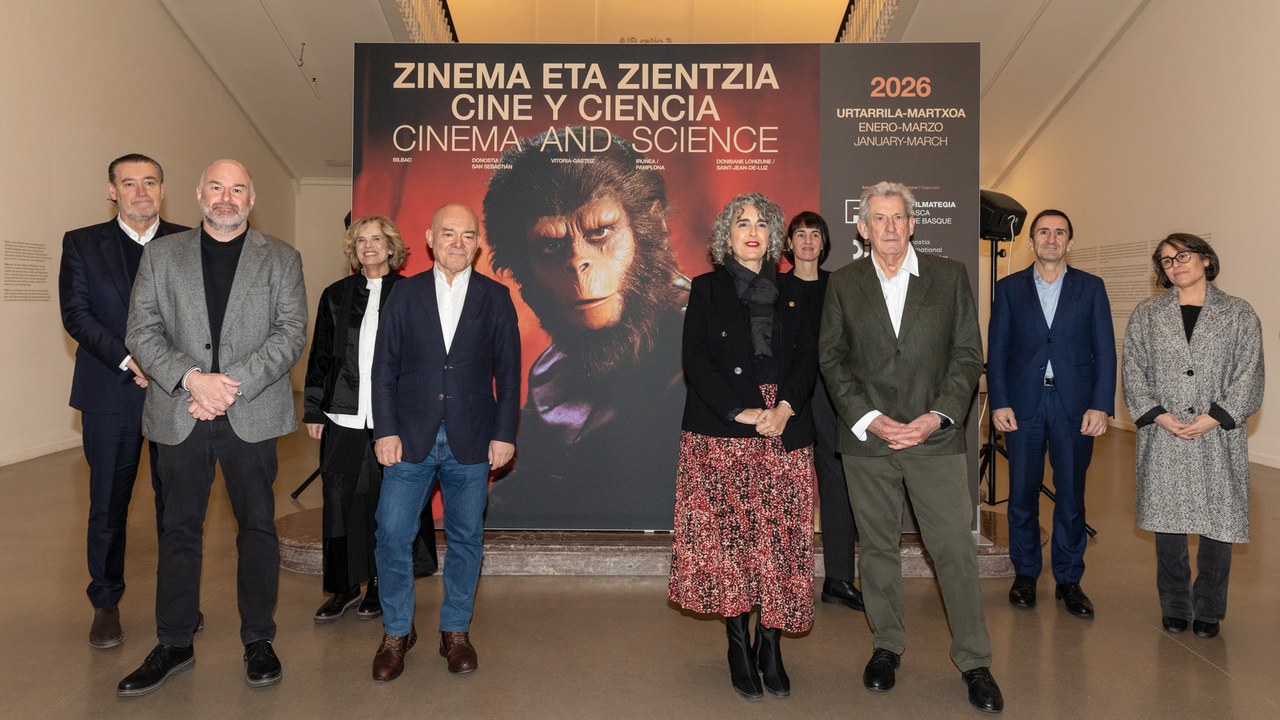
The start of a new year also marks the return of the ‘Cinema and Science’ cycle. Now in its ninth edition, the program invites the public to explore some of the great scientific and humanistic questions that have shaped our relationship with the world. Organized by the Basque Film Archive, Donostia International Physics Center (DIPC), and the San Sebastián Film Festival, the series will visit its usual venues in Vitoria-Gasteiz (Artium Museoa), Donostia/San Sebastián (Tabakalera International Center for Contemporary Culture), the Bilbao Fine Arts Museum (currently at Bizkaia Aretoa-Sala Mitxelena de EHU), Pamplona (Golem Baiona cinemas), and Saint-Jean-de-Luz (Cinéma Le Sélect), with a selection of films that engage in dialogue with disciplines as diverse as biology, physics, ecology, anthropology, mathematics, and contemporary ethics.
This was announced at a press conference held today at Tabakalera, attended by Ibone Bengoetxea, Deputy President and Minister of Culture and Language Policy; Juan Ignacio Pérez Iglesias, Minister of Science, Universities, and Innovation; Joxean Fernández, Director of the Basque Film Archive; and Ricardo Díez Muiño, Director of DIPC. Also in attendance were Pedro Miguel Etxenike, President of DIPC; Miguel Zugaza, Director of the Bilbao Fine Arts Museum; Maialen Beloki, Deputy Director of the San Sebastian Film Festival; Beatriz Herráez, Director of Artium Museoa; and Edurne Ormazabal, General Director of Tabakalera.
To begin with, Bengoetxea emphasized the importance of collaboration between institutions and various agents in transmitting culture and science through this series: "Culture and science are two tools for social cohesion. In this project, both come together to build knowledge, critical thinking, and shared values as a society. Science acquires a more accessible, familiar, and understandable language through cinema, thus becoming a tool for social transformation."
At the same time, Pérez Iglesias stated that "science appears where one expects to find it, of course. But it also appears, and not infrequently, where one least expects it. Cinema, for its part, shows us natural phenomena, animal behavior, human traits, interpersonal relationships, social transformations and conflicts, and countless facets of our world and our lives. So it should come as no surprise that countless films are full of events, plots, and adventures about which science has a lot to say."
For his part, Díez Muiño emphasized that "in this cycle, and based on its relationship with cinema, we propose a different approach to science and its impact on society. Films reflect and stimulate many of the ideas, concerns, interests, utopias, and dystopias that emerge in the human mind when confronted with scientific and technological advances. Works of fiction can humanize very complex problems by proposing alternative visions to the purely technical."
To conclude, Fernández recalled that the spirit of the series has remained intact since its inception: “Through ‘Cinema and Science,’ we see that cinematic language reveals the beauty of science, while the universality of scientific thought helps shed light on the beautiful moving images that move us on screen.” He also revealed that this ninth edition has once again opted for plurality, for films that, “sometimes without explicitly talking about science, do allow for a scientific perspective.”
FILMS
The cycle kicks off today in Vitoria-Gasteiz with Planet of the Apes, a subversive science fiction classic that invites reflection on humanity's progress and setbacks, authoritarian tendencies, and “the peculiar beauties that ravages and confusion can bring us,” in the words of Susan Sontag. The film will be presented by physicist, writer, and Ikerbasque research professor at DIPC, Juan José Gómez Cadenas, at this afternoon's screening and tomorrow's screening in Pamplona, while in San Sebastián (on the 9th) and Bilbao (on the 10th), it will be presented by Pedro Miguel Etxenike, Prince of Asturias Award winner and president of the DIPC.
This first screening will be followed by Haur basatia, the story of a feral child that French director François Truffaut filmed to quietly bring audiences closer to the emotion of what is intrinsically human, of affection and the discovery of language. For its part, Sare Soziala (The Social Network), director David Fincher and screenwriter Aaron Sorkin's portrait of the origins of social media, will take the audience to a defining starting point of the present day.
The cycle will also venture into the realm of animal behavior and collective risk with The Birds, Hitchcock's film that continues to inspire scientific interpretations of instinct, fear, and the human relationship with an environment that sometimes rebels. At the same time, as part of Emakumeak Zientzian, the film Sisters with Transistors will be screened, highlighting and delving into the history of the pioneers of electronic music.
The biological and ethical dimensions will feature particularly strongly in La mosca (The Fly), Cronenberg's drama that invites reflection on mutation, bodily limits, and experimentation.
Humor will be provided by Irakasle zoroa, while La Voie Royale tells the story of a young woman whose talent and interest in mathematics lead her down paths she did not seem destined to follow.
Finally, the cycle will delve into reflections on the end of life with Los destellos (The Flashes), European memory with Hirugarren gizona (The Third Boy), anthropological reflection with La balada de Narayama (The Ballad of Narayama), and the ecological and futuristic sensibility of Nausicaä del Valle del Viento (Nausicaä of the Valley of the Wind), which will close the edition and also feature in the school sessions in Donostia, Bilbao, and Vitoria-Gasteiz.
PRESENTATIONS
Throughout these months, each film will be presented by specialists from DIPC, the University of the Basque Country, research centers, and fields such as biology, chemistry, acoustics, anthropology, and philosophy.
Specifically, the presentations will be given by the aforementioned Pedro Miguel Etxenike and Juan José Gómez Cadenas, as well as Amaia Carrión-Castillo Ikerbasque researcher in Educational Neuroscience and Developmental Disorders at BCBL); Antonio Casado da Rocha (permanent researcher in the Department of Philosophy of Values and Social Anthropology at the University of the Basque Country); Juan Ignacio Pérez Iglesias (PhD in Biology and Professor of Physiology at the University of the Basque Country and current advisor to the Basque Government on Universities, Science, and Innovation); Gabriel Berasategui (biologist); Mónica Bello (former director of Arts at CERN); Lorea Argarate (technologist, science communicator, and musician from Bilbao who has received the Gladys Award); Ginés Morata (biologist and Princess of Asturias Award for Technical and Scientific Research); Beatriz Díaz (PhD in Biology and specialist in entomology, currently working at Aranzadi); Xabier López (chemist, professor at the University of the Basque Country and associate of DIPC); Eva Ferreira (professor of Applied Economics and former rector of the University of the Basque Country); Ander Urrutikoetxea (oncologist at the Gipuzkoa-Osakidetza Cancer Unit and president of GEICAM); Pilar Palomero (renowned film director and screenwriter); Itziar Alkorta (doctor of Biochemistry from the EHU); María Jesús Goikoetxea Iturregui (doctor of Human Rights), Aitzpea Leizaola (doctor of Social Anthropology and director of the official Master's Degree in Anthropology at EHU); Ibone Ametzaga (professor of ecology at EHU); and Bosco Imbert (researcher and professor of ecology at the Public University of Navarre).
The program will be screened in its entirety in San Sebastián, Bilbao, Vitoria, and Pamplona, while in San Juan de Luz, viewers will be able to enjoy Haur Basatia, Sare soziala, La mosca, Hirugarren gizona, The Ballad of Narayama, and Nausicaä of the Valley of the Wind.
OTHER ACTIVITIES
The ninth edition of the ‘Cinema and Science’ series includes other parallel activities. On February 12, at 6:00 p.m. in Room Z at Tabakalera, the day before the screening of ‘The Fly’ in Donostia, biologist Ginés Morata, who won the Prince of Asturias Award for Scientific and Technical Research in 2007, will give a lecture in which he will discuss the issues raised by the film with the audience.
On the other hand, on March 6, also at 6:00 p.m. in Room Z at Tabakalera and in collaboration with Biogipuzkoa, there will be a round table discussion entitled “The End of Life: Literature, Film, and Science” led by Pilar Palomero and Ander Urruticoechea. The round table will address issues related to the film “Los destellos” (The Flashes), directed by Palomero herself, and will be moderated by Itziar Vergara, scientific director of the IIS Biogipuzkoa.
Tickets can be purchased on the websites and at the box offices of Tabakalera, Artium Museoa, the Bilbao Fine Arts Museum, and the Le Sélect and Golem-Baiona cinemas. Tickets cost between €3.50 and €6, excluding discounts. In addition, the talk and round table discussion will be free and open to the public until full capacity is reached. All information can be found on the website www.filmoteka.eus.