
Impact of structural degrees of freedom on charge order and superconductivity in transition metal dichalcogenides
PhD Program
- Speaker
-
Sandra Sajan
DIPC - When
-
2026/11/27
11:00 - Place
- CFM
- Add to calendar
-
 iCal
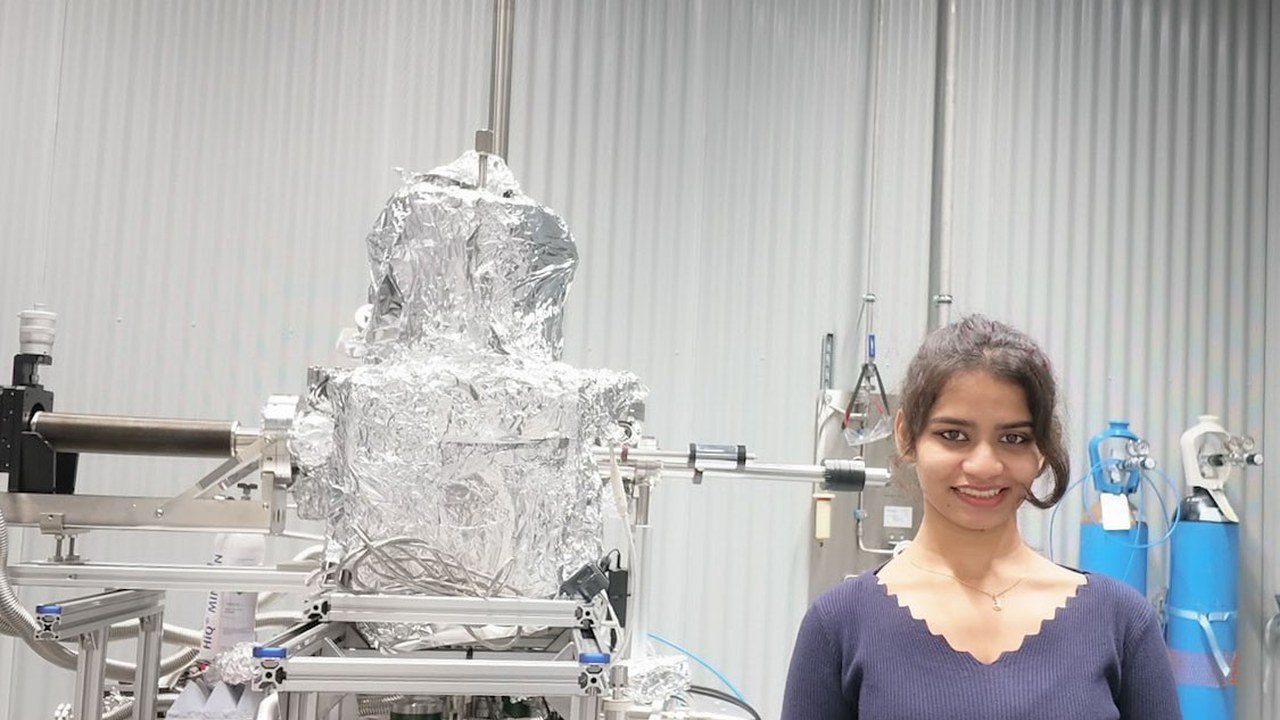
PhD Thesis defense by Sandra Sajan
Supervisor: Miguel Moreno Ugeda (Ikerbasque Research Professor)
Transition-Metal Dichalcogenides; Charge-Density Waves; Superconductivity; Scanning Tunnelling Microscopy and Spectroscopy
How do structural degrees of freedom influence charge order and superconductivity in layered quantum materials? This question lies at the heart of this thesis, which explores how crystal symmetry, polytypism and interlayer interactions affect collective electronic phases in Ta- and Nb-based transition metal dichalcogenides. Using low-temperature scanning tunneling microscopy and spectroscopy, we investigate the relationship between atomic-scale structure and the emergence, coexistence and competition of charge-density waves (CDWs) and superconductivity.
We first investigate how different crystal structures within the TaSSe family influence charge order and superconductivity, focusing on the 1T and 4Hb polytypes. In 1T-TaSSe, we explore how selenization disrupts the long-range coherence of the CDW, producing a mosaic state associated with the emergence of superconductivity. In 4Hb-TaSSe, the alternating stacking of T- and H-type layers enables the coexistence of two spatially distinct superconducting condensates. Using quasiparticle tunneling and Andreev reflection spectroscopy, we identify superconducting gaps of different magnitudes in the two types of layers, with signatures consistent with weakly coupled condensates, potentially of different pairing symmetries. Their distinct critical temperatures and upper critical magnetic fields further support this picture.
We then examine the role of interlayer interactions in TaS₂-based misfit compounds, where the incommensurate stacking of dissimilar layers introduces charge transfer and moiré potentials that reshape charge order and break rotational symmetry. Finally, we compare the 2H and 4Ha polytypes of NbSe₂ to investigate how stacking sequence influences CDW order and superconductivity. In 4Ha-NbSe₂, we identify coexisting charge-order configurations, including an intrinsic unidirectional 1Q phase, as well as phase-slip vortices and discommensurations that reveal the complex spatial organization of the CDW.
This work illustrates how different structural degrees of freedom, from local disorder and crystal symmetry to interlayer stacking and incommensurability, affect the properties of charge order and superconductivity. The results establish a microscopic connection between crystal structure and collective electronic phases, highlighting the potential of structural engineering to control their properties in layered quantum materials.