
Revealing how minuscule magnetic impurities disrupt superconductivity
2026
Apr
24
An international team led by the Autonomous University of Madrid (UAM), in collaboration with the Niels Bohr Institute (NBI), the Donostia International Physics Centre (DIPC), the University of Valencia and centres in Argentina and the Netherlands, has demonstrated that minuscule amounts of magnetic impurities combined with structural disorder are sufficient to destroy the energy gap in a conventional superconductor. The finding, published in Advanced Materials, challenges some classical predictions about the extent to which superconductivity tolerates imperfections, and could have implications for the design of future quantum devices.
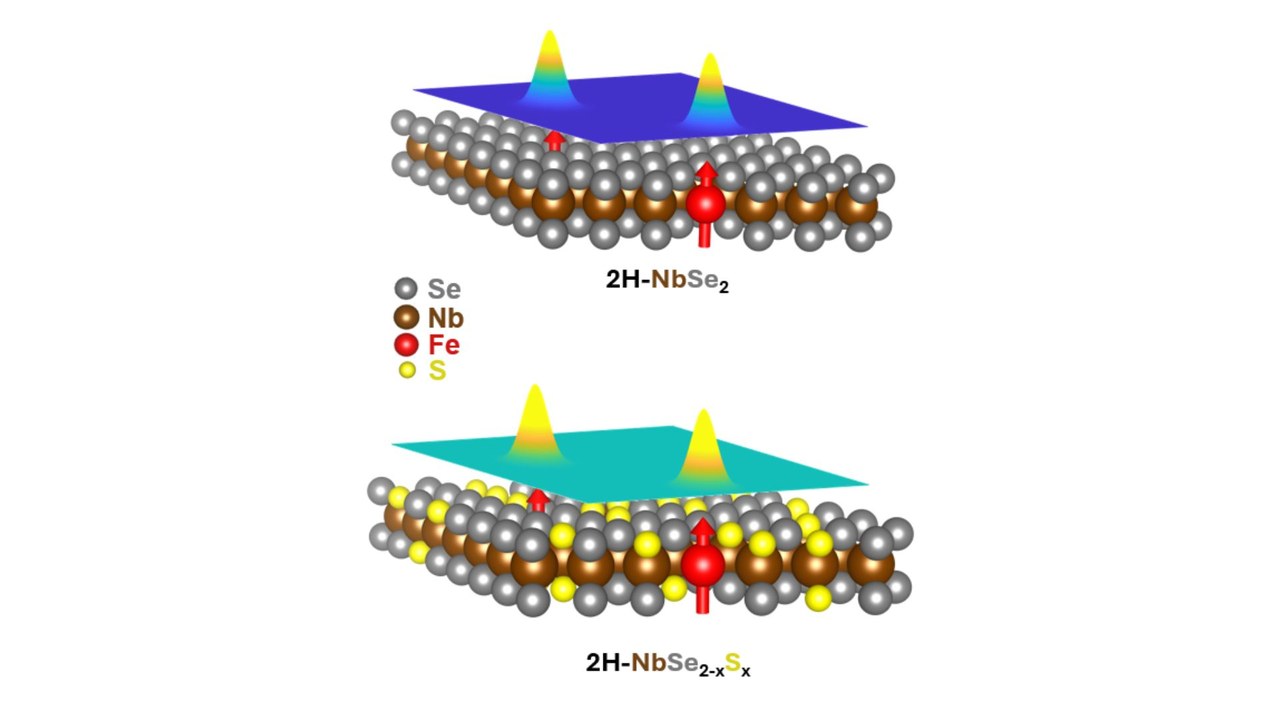
A team from the Low-Temperature and High-Magnetic-Field Laboratory at the Autonomous University of Madrid (UAM), in collaboration with scientists from the Niels Bohr Institute, the Donostia International Physics Centre (DIPC), the University of Valencia and centres in Argentina and the Netherlands, came across an unexpected behaviour in a superconducting material when it contains extremely small amounts of magnetic impurities. The study, published in the journal Advanced Materials, shows that tiny concentrations of iron —as little as 150 parts per million— can eliminate a fundamental property of superconductivity when the material also displays a certain degree of structural disorder.
The material analysed was niobium diselenide (2H-NbSe₂), a widely studied superconductor. The researchers investigated what happens when some of the selenium is replaced by sulphur, and the crystal also contains isolated iron atoms. The result was surprising: a single iron atom for every 3,000 crystal cells suffices to eliminate the so-called superconducting gap, a characteristic often regarded as a key property of the superconducting state, but which, as this study demonstrated, is not so crucial.
This phenomenon is known as gapless superconductivity and to date has been regarded as relatively rare. The researchers' findings show that it appears at much lower concentrations of impurities than predicted by the classical theories developed over half a century ago, and that it may be far more common than expected.
Superconductivity is a quantum phenomenon occurring at extremely low temperatures and allows electricity to flow without resistance. This happens because electrons group together in pairs —known as Cooper pairs— and move in a coordinated manner through the material. One of the characteristics of this state is the emergence of an energy gap, which acts as a kind of protective barrier. To break a pair of electrons, a minimum amount of energy at least has to be supplied. This is often used to explain why the superconducting state is stable in the presence of disruptions.
In some exceptional cases, this barrier disappears partially. After that, electronic states where they should not normally exist appear, and the material enters what is known as gapless superconductivity. In this state, superconductivity persists, demonstrating that the stability of the superconducting phenomenon is not measured by the gap but by other quantities, such as temperature, current or magnetic field, which can be tolerated by the superconductor. So much so that gapless superconductors are of particular interest because they can give rise to unusual quantum phenomena, including possible Majorana states, which are considered to be particularly robust and are being investigated for their potential in future quantum computing technologies.
An unexpected consequence of imperfections
For decades, the physics of superconductivity has held that non-magnetic disorder has little effect on conventional superconductors. According to the Anderson theorem, minor structural imperfections should not significantly alter its properties. However, the new study shows that the situation may be far more complex. When three factors —highly diluted magnetic impurities, structural disorder and changes in the electronic structure of the crystal—come together in this material, the effect on superconductivity may be much stronger than expected. In other words, different types of imperfections can reinforce each other’s effects and weaken the superconducting gap with surprising efficiency.
Maria Navarro Gastiasoro, researcher at DIPC and co-author of the study, states: "The obtained microscopic theoretical results, performed at NBI and DIPC, successfully reproduce the experimental observations at a qualitative level. These new results highlight the important role played by structural disorder, which has been mostly neglected in the literature. Moreover, there are still some discrepancies between the microscopic calculations and the experimental data, suggesting that the model underestimates the cooperative influence of structural disorder, or that there may be additional relevant degrees of freedom at play."
According to the authors, the finding shows that the way in which imperfections affect superconductors may depend far more on the electronic features of the material than previously thought. That is why the theoretical models will need to take these specific characteristics into account in order to accurately describe the behaviour of each system.
Source: UAM Gazette
Publication reference
Jose Antonio Moreno, Mercè Roig, Víctor Barrena, Edwin Herrera, Alberto M. Ruiz, Samuel Mañas-Valero, Antón Fente, Anita Smeets, Jazmín Aragón, Yanina Fasano, Beilun Wu, Maria N. Gastiasoro, Eugenio Coronado, José J. Baldoví, Brian M. Andersen, Isabel Guillamón, and Hermann Suderow.
Gapless Superconductivity From Extremely Dilute Magnetic Disorder in 2H-NbSe₂₋ₓSₓ.
Advanced Materials (2026).