The DIPC launches a new programme of international scientific meetings to boost collaborative research
2026
Sep
7
In September 2026, DIPC will launch SPARK, an annual initiative that will bring together around 50 researchers from around the world for four weeks to address cutting-edge scientific challenges through a collaborative and interdisciplinary format.
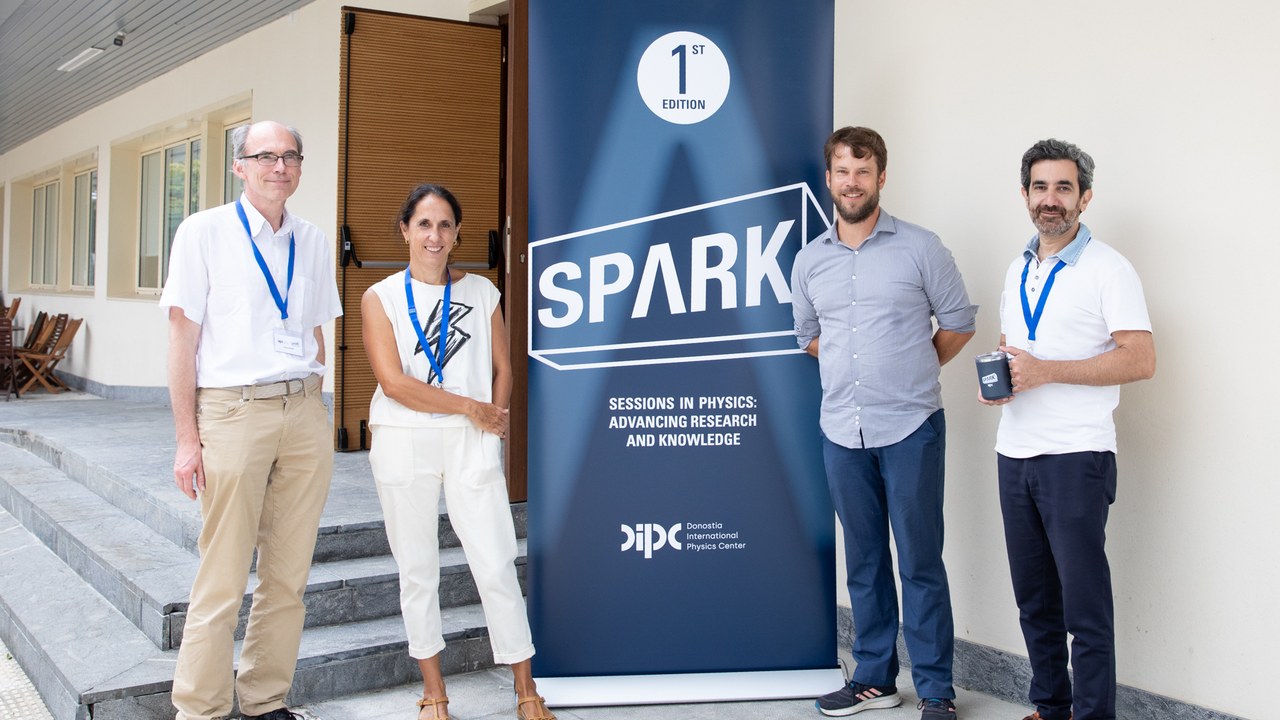
In September 2026, DIPC will launch SPARK – Sessions in Physics: Research and Knowledge. This new, annual initiative will bring together researchers from across the globe to address cutting-edge scientific challenges in a collaborative and interdisciplinary environment.
Each edition will gather around 50 local, national and international scientists at the DIPC’s facilities for a period of four weeks. Through an intensive format of small-group collaborations, informal seminars, tutorials and lectures, participants will work together on a specific research topic, fostering an open environment for scientific debate and generation of new perspectives.
The inaugural edition will be dedicated to ‘Exotic Quantum Matter’ and strategies for its measurement and control, an area of research that has great potential for broadening knowledge of complex quantum systems and their future applications. The workshop will be attended by experts working with different quantum platforms and theoretical researchers specialised in developing methods for describing many-body quantum effects. The participants include Francesca Ferlaino, who was named Austrian Scientist of the Year in 2025. She is an international leader in the study of quantum matter and a pioneer in the research of ultracold gases of magnetic atoms and new quantum states. She is also the co-organiser of this first SPARK edition. Another participant is Ignacio Cirac, one of the world’s leading theoretical physicists in quantum information and computing. He is the director of the Theory Division at the Max Planck Institute for Quantum Optics. He has received some of the most prestigious international scientific awards in recognition of his career, including the Prince of Asturias Award for Scientific and Technical Research (2006) and the Wolf Prize in Physics (2013). The combination of these profiles will enable scientific challenges to be addressed from different approaches and will foster the creation of new collaborations across disciplines.
One of the distinctive characteristics of SPARK will be its participatory format. The daily programme of activities will be designed and managed by the participants themselves ─with support from the organisers─ so that it can be adapted to the scientific needs that arise during the work weeks. This model is aimed at creating a dynamic, highly interactive environment in which the continuous exchange of knowledge drives creativity and leads to new ideas.
The participants will be staying at facilities provided by the DIPC, which will encourage continuous contact outside of the scientific sessions. This approach seeks to enhance informal interactions, which often play a key role in creating new collaborations and research projects.
Through SPARK, the DIPC hopes to establish a new annual event dedicated to high-quality physics research. Although the programme will continue to form part of future editions, the intensive nature of each workshop means that only a limited number of meetings can be organised each year. This will ensure a work format focused on the quality of the interactions and the scientific impact of each edition.